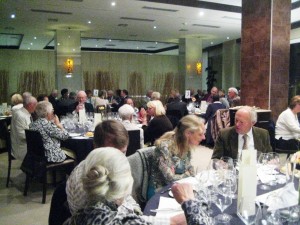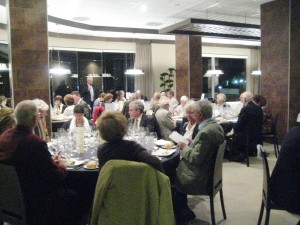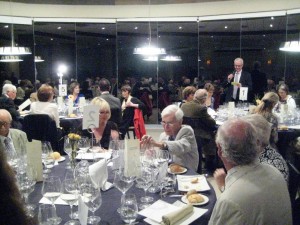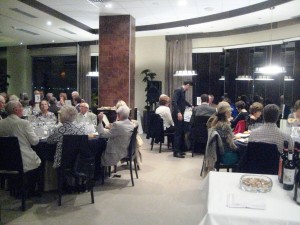
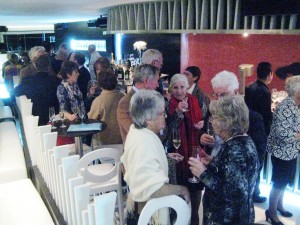
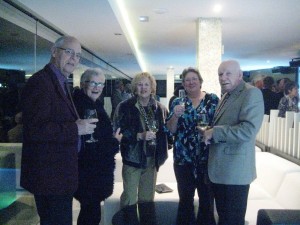
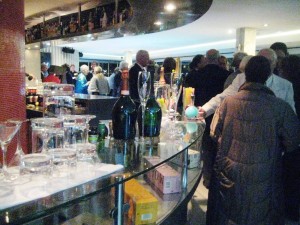
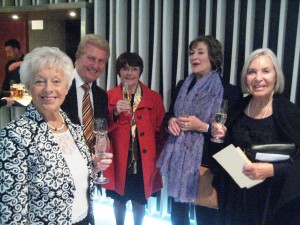
Members enjoying pre dinner drinks in the Champagne Bar
This tasting, which was held at the Restaurant Abiss in Calpe, an established favourite venue for the Society, followed on immediately from the Annual General Meeting and was attended by 63 members and guests. As is customary, the newly elected President presents his personal wine selection at this tasting. John Sloggie, who had been elected an hour previously, chose to present his wines in conjunction with his Vice President Paul Nicholls who had also just been elected. The cost of each wine, where it can be purchased and average score given by members is shown in the list of wines tasted in 2016, which can be found by clicking on http://www.cbws.eu/archive/wines-tasted-in-2016-3/
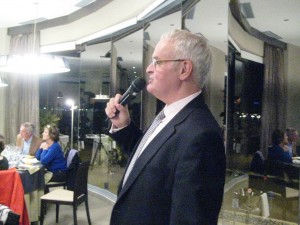
John Sloggie introducing his wine
The first wine, presented by John, was Seminare 2014 which members last tasted in March 2015. It is a Vino de la Tierra, from the bodega of that name, located in Val do Miño in the area of Ribeira in Galicia. It is unusual in that it is a blend of Albariño, Godello and Treixadura. Produced by cold maceration of the pulp by applying dry ice for 6-8 hours, it is fermented in stainless steel tanks prior to bottling. The wine is clear, clean and a pale yellow colour with green hues and an intense and elegant nose with primary aromas of peach and apricot and light tropical notes of pineapple and mango. In the mouth it is round, smooth and slightly sweet with excellent acidity and structure, slightly bitter and very long finish. It has an Alcohol by Volume (ABV) of 13%.
Wine 2 was Essens 2014, from bodega Vinessens in DO Alicante, a 100% Chardonnay. Chardonnay has three distinct flavours influenced by the climate it is grown in: cold, moderate or hot. The wine presented by Paul was in the latter category having been grown in Villena, Alicante. Careful manual harvesting is followed by cold storage at 4ºC for 24 hours and after a second selection process there is a further 24 hours maceration at 8ºC prior to initial fermentation. A fortnight’s cold fermentation at 12-13ºC in 500 litre open French oak barrels is followed by a further 60 days in closed barrels, doing weekly battonage to enhance the complexity of the wine. (Battonage is the process of stirring wines while they remain in their barrels on their yeast lees). Pale yellow in colour with green tones, it is elegant on the nose with both citrus and white flower aromas and fennel hints. The wine displayed rich, ripe tropical fruit notes like pineapple and mango, bananas or figs. Fresh acidity and good structure make this an extremely drinkable white wine with a smooth woody finish. It has an ABV of 13%.
John presented the third wine tasted; Rectoral de Amandi 2014, from DO Ribeira Sacra in Galicia. Bodega Rectoral de Amandi gets its name from an ancient church of the seventeenth century, in the heart of the Ribeira Sacra. This winery has become the flagship of the whole Ribeira Sacra D.O., not only for being the largest winery in volume with more than 2.0 million bottles a year, but also for being directly responsible for the development, communication and recognition of the D.O. beyond its borders. The Bodega is part of the Bodegas Gallegas group which has 5 wineries in Galicia and sells over 25 million bottles a year to over 50 countries. This is the only wine produced in this bodega. The prominent grape in this region is Mencia and the Rectoral is 100% Mencia and has an ABV of 12.5%. It has a cherry colour with violet rim and a superb, ripe fruit aroma, well balanced with a silky finish.
Paul presented the fourth wine, Tarima Orgánico 2014 which is a D.O. Alicante red wine by
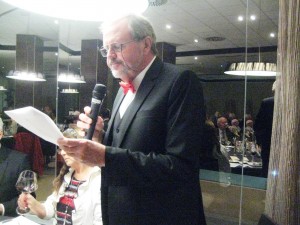
Paul Nicholls speaking about a wine
Bodegas Volver. This wine is a single varietal Monastrell from organically farmed vines. They are cultivated at 700 metres above sea level, between the Sierra de Salinas and the Sierra de Sima. The vineyards were planted between 1992 and 1997 and without an irrigation system. The soils are generally poor in organic matter, with calcareous rocks on the surface providing a high level of calcium and lime, aggregates and shallow soils and aggregates. The grapes are manually harvested and meticulously selected. Later, the wine ferments in stainless steel tanks on its lees. Opaque ruby in colour with lively cherry and dark berry aromas, complicated by notes of cracked pepper and wood smoke. It is chewy and focused on the palate, offering bitter cherry and blackberry flavours and a lot of peppery spices. Tastes are supple and long lasting, with a hint of bitter chocolate and youthful tannic grip. It has an ABV of 14.5%
John presented the final wine we tasted which was Mernat 2009, from Bodega Tierras de Orgaz in the DO Vino de La Tierra de Castilla. Tierras de Orgaz is a unique vineyard within the region, which has a privileged microclimate typical of continental areas. Thanks to the altitude of the land and the protection offered by the mountains, the vines enjoy a climate of significant temperature contrasts, enabling a slower ripening and, thus, more concentration and quality of the skins, conferring freshness, body and a variety of subtle flavours to the wine. The soil of Bodegas Tierras de Orgaz is of a medium/strong type with different textures that range from the loamy-clay-sandy to the silty, including pH-neutral loamy-clay and non-saline soils. Mernat 2009, with an ABV of 13.5% is an unusual blend of Tempranillo, Cabernet Sauvignon, Merlot, Syrah and Petit Verdot. It has a cherry colour with a garnet rim and an aroma of ripe fruits, wild herbs and is earthy and spicy. In the mouth the wine is fruity, fresh, elegant and perfect acidity, with slight hints of oak balancing the whole.
The vote of thanks was given to both speakers by Rod Anderton