
Restaurant Puerto Blanco, Calpe – 20th June 2013
The ever popular and regular June venue of Puerto Blanco saw 74 members and guests assembled for a tasting of Alicante wines presented under the aegis of Don Salvador Algarra, the Vice President of the Consejo Regulador of the Alicante DO. Also present were Eladio Martin from the Consejo Regulador who spoke about the Alicante DO and its wines, Javier Espi an international sommelier and Alicante’s best sommelier in 2010, who presented each of the wines tasted and Encarni and Diego Gonzales from Bodegas Bocopa. The prices quoted for each wine are approximate and those for which the wines can generally be purchased in supermarkets or bodegas.
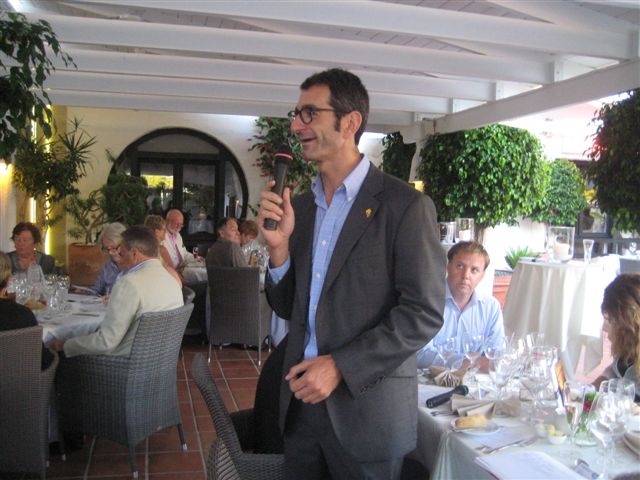
Eladio Martin
The welcoming aperitif was Marina Espumante a quality aromatic sparkling Muscat wine from Bodegas Bocopa. Naturally fermented using the Charmat method (see note at end) it has small bubbles, lightweight and fast which gave it a refreshing sparkle. Despite being a Brut wine, it was slightly sweet and fruity. It is 7% Alcohol by Volume (ABV) and gets 87 points and exceptional value in the Guía Peñín at about 6€.
Three wines then accompanied the selection of starters. Fruto Noble is a 100% organic Sauvignon Blanc from Bodegas Francisco Gomez. It has an ABV of 12% and has won a dozen awards in the last three years. A fresh young white wine, it exhibits a bright, clean greenish yellow colour. Flavoursome and powerful on the palate it has a touch of acidity that gives a freshness to the finish. It cost between 6€ and 9€. Cesilia Rosé is a rosado from Viñedo y Bodega Heretat de Cesilia and is a blend of 85% Merlot and 15% Monastrell with an ABV of 13% Grapes are hand picked early in the morning and pressed slowly and softly. After this, the grape juice is places in equal parts in French oak barrels and in stainless steel tanks to be fermented at a temperature of 15º to 18º degrees. It is aged for six months and goes through a weekly process of “batonage”. It has a salmon pink colour with a note of raspberry and strawberry, with a smooth palate and a lingering after taste. The Guía Peñín gives it 86 points and good value at 9€ to 10€. Laudum Chardonnay 2011 from Bodegas Bocopa is as the name implies a 100% Chardonnay which is fermented in new French oak. A pale greenish yellow is has a classic chardonnay aroma and taste and is given 87 points and exceptional value in the Guía Peñín at approximately 5€
Then followed three wines to accompany the main course. Beryna 2010 from Bodegas Bernabé Navarro which is a blend of five vines whose ages average from 15-50 years; 70% Monastrell, 15% Tempranillo, 5% Syrah, 5%Merlot, 5% Cabernet-Sauvignon. Fermentation is carried out by individual varieties and it spends 14 months in French oak with 4 rackings. It has a red cherry colour with a violet meniscus and an aroma of red and black fruits and an ABV of 14.5%. The Guía Peñín awards it 92 points and excellent value at about 8€. Sein 2010 Crianza from bodega Vinessens is a blend of 60% Monastrell and 40% Syrah. All grapes are harvested manually and undergo a strict selection process. Malolactic fermentation takes place for 12 months in French and American oak barrels. A well rounded, silky wine with deep cherry and purple tones, it has a good body and structure and a lasting finish. It receives 92 points in the Guía Peñín and is classed as excellent value for between 8.5€ and 10€. Laudum Crianza from Bodegas Bocopa is made from the finest Monastrell grapes from old vines and then rounded off with Cabernet-Sauvignon and Merlot grapes to satisfy the taste of the oenologist. It was then aged for 16 months in new American and French oak casks. It is a deep cherry red with an aroma of spices and vanilla, perfectly integrated with oak giving it a balanced and meaty palate and all the structure and persistence of a full bodied wine. It receives 84 points in the Guía Peñín and cost approximately 6€.
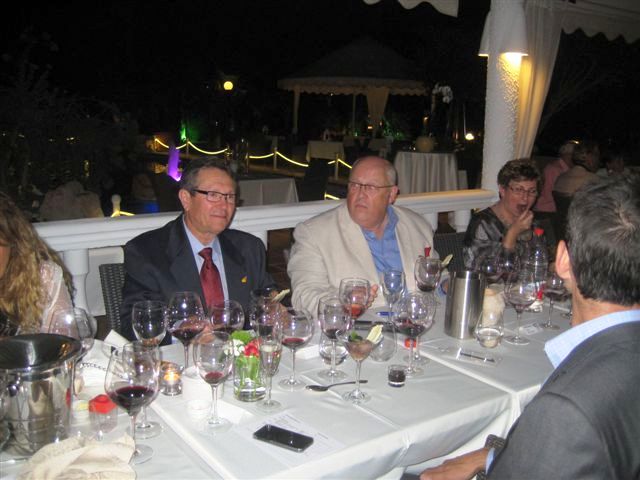
Salvador Algarrra and Andrew Johnson
The Chocolate dessert, Godiva in different textures, was accompanied by Dulce Negra a 100% Monastrell and crushed liqueur from Bodegas Bocopa. As its name suggests it was a sweet dessert wine with tones of marmalade, brown sugar and spices. The Colour was intense cherry with violet and vermilion border between. The taste was very sweet, fruity, meaty and powerful. It has a large aftertaste and can be purchased for about 9.6€ from most supermarkets.
In all seven wines were tasted, an exceptional number for one of the Society’s tastings. A vote of thanks was given to all the speakers by Mary Anderton in both Spanish and English.
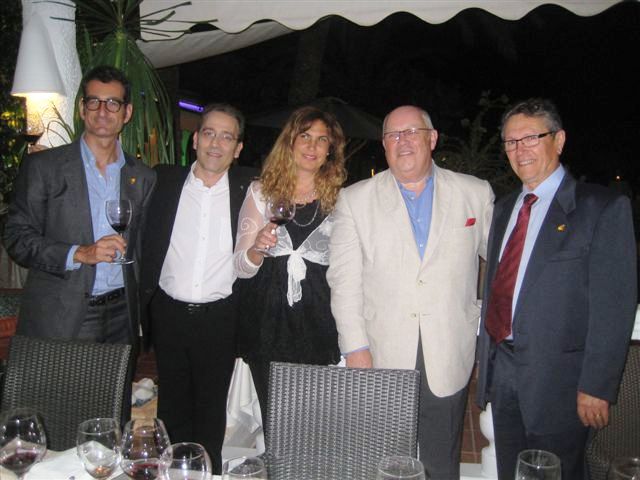
Andrew Johnson with our guests
The Charmat method was, created by a French vine grower in Saint-Pourçain-sur-Sioule, in which the wine undergoes a secondary fermentation in bulk tanks, and is bottled under pressure. This method is used for Prosecco and Asti in particular, and produces smaller, longer-lasting bubbles. This is now used widely around the world to produce light, delicate sparkling wines.