
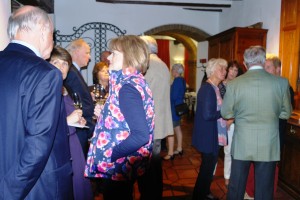
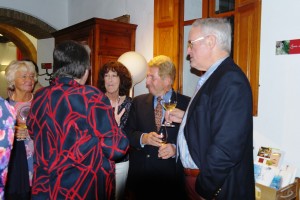
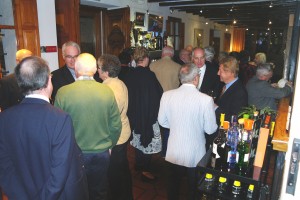
Members enjoying pre dinner drinks
After an enjoyable Christmas evening at
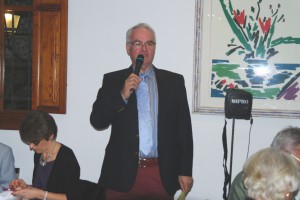
John Sloggie opening the proceedings
this restaurant last year, 62 members returned to the La Senia in Denia for the March tasting. This restaurant has a nice cosy atmosphere and serves excellent food, setting the scene for members to enjoy the return evening. Members were welcomed by the recently elected President John Sloggie for a tasting of Vinos de Pago conducted by Society members Cherry and Tony Cabban. The cost of each wine, where it can be purchased and average score given by members is shown in the list of wines tasted in 2016, which can be found by clicking on “Wines tasted in 2016”.

Cherry Cabban introducing Vinos de Pago
Cherry gave an introduction to the tasting and an excellent and detailed dissertation on Vinos de Pago, which unfortunately can only be summarised here. Cherry explained that Pago means farm or estate, so the simple explanation of what constitutes a Vino de Pago is that it is an estate wine, from a vineyard that is perceived to be one of the great estates of Spain. The wine from a DO Pago must be wholly created and bottled within that domain, the grapes must be grown within the domain and the estate must have some unique qualities like soil or its microclimate when compared to surrounding areas.. It is a very long process to gain a Vino de Pago status. It can take from 4 to 8 years, and since 2003 only 17 Wine growers have achieved the category. Fewer than half of Spain’s regions have ratified the Vino de Pago legislation. Which is why you will not find Vino de Pago from Rioja, Ribera del Duero or Priorat. The wineries are inspected twice a year, once during the harvest and once during the wine making process. As part of the strict control process, the reports are sent to Brussels to make sure they meet EU criteria.
Tony Cabban introduced all the wines for the evening and the detailed descriptions he gave can also unfortunately only be summarised in this report.
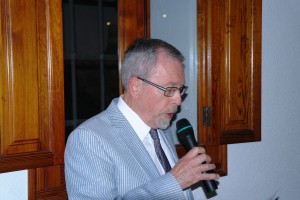
Tony Cabban introducing the wines
The first wine was Pilas Bonas Blanco 2015, which comes from the Bodega Pago Casa del Blanco located in Manzanares about 150 kms south of Madrid. It is made of 50% Sauvignon Blanc and 50% Chardonnay. The Alcohol by Volume (ABV) is 12.5% .It is harvested between 5.00 and 7 o’clock in the morning to ensure it remains cool and since they are located at 750 metres altitude in the middle of Spain they are sure to be cold at that time of the day. They harvest about 2.5 kgs per plant to ensure best quality. That would compare with neighbours whose vines yield 5 times that amount with resultant much lower quality. They achieve that low yield by hard pruning in February /March time. The wine had a pale yellow colour, with a fresh and intense nose with a hint of ripe pears and pineapple with notes of figs and dry hay. In tasting the acidity contrasts with the strong fruit flavour.
The second wine called Serendipia, comes from Pago Ayles located 35 kms south of Zaragoza in the Carineña DO. The vineyards cover 173 acres and first achieved Vino de Pago status in 2010, qualifying due to their microclimate and soil being very different from their neighbours. Serendipia 2014, a 100% Chardonnay, is not yet officially a Vino de Pago because the vines are not yet old enough, but they will be very soon. However they qualify in every other respect as a Pago. Cherry and Tony thought it was so close to being one and they liked it so much that they decided to include it tonight. They also included it because the other white they had originally chosen from Dehesa de Carrizal was totally out of stock everywhere; including the winery itself. This wine has an ABV of13.5%. The tasting notes say: A bright yellow colour, the nose: tropical fruits, white flowers, balanced with notes of vanilla & crème brulee. Taste: medium body with good mouth feel, with bright and crisp finish. The Guía Peñín awards it 90 points.
Wine number three is called Ayles “ e”. It is “e” for España because they name their wines starting with “a” the first letter of the word Ayles and so on until they reach “s” It is 100% 2012 Tempranillo wine with an ABV of 13.5% and is produced by the same bodega, Pago Ayles, as the second white we tasted. It is a vino de Pago and again it has limited production, just 8,500 bottles. It is aged 10 months in French Oak and then spends about 18 months in the bottle. The unique terroir is influenced by a tributary of the Ebro on one side and with a small mountain range behind, which creates a cooler microclimate than the surrounding properties. The soil is a mixture of clay, limestone and chalk, which is ideal for the Tempranillo vine in this area. The colour of the wine is dark reddish purple with cherry red towards the edge of the glass. It has a nose of cherry, blackberry, smoke and rosemary, a bit of anise and minerally earth. In the mouth it hovers in between medium and full bodied and has soft and elegant tannins, with crisp acidity that keep the mouth fresh. Good length on the finish. The Guía Peñín awards it 90 points.
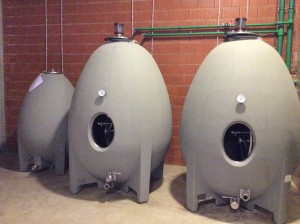 The fourth wine, Las Ocho 2012, is made by Chozas Carrascal which was the second winery in the Utiel Requena area to achieve Vino de Pago status in 2012. It was first tasted by some society members on the autumn 2015 wine trip when they visited the bodega. They have a large area of 100 year old Bobal vines on their estate but all the other 11 vine varieties were not planted until 1992 and its first wine was launched in 2003. Las Ocho is so named because it contains 8 grape varieties: Bobal, Monastrell, Garnacha Tinta, Tempranillo, Cabernet Sauvignon, Cabernet Franc, Syrah and Merlot. The wine is aged in French oak barrels for 14 months and further 12 months in bottles. The estate sits at 700m above sea level making for hot summers, cold winters and large daily temperature variations. Harvest by hand takes place at daybreak in order to retain freshness in the grapes, and as the winery is onsite, their time in transit is minimal and they are delivered to the maceration tanks at their best. The bodega is experimenting with egg shaped grey cement containers ranging from 1.50m to 3 m tall. And finding that amongst the advantages compared with stainless steel were: better insulation, thus energy saving, natural slow circular movement of the liquid around the container caused by the tiny temperature difference from the top to the bottom of the egg, and it seems they preserve the flavour and aromas much better than stainless steel. Las Ocho 2012 had a ruby red colour and was clean and bright. On the nose it had fruit, balsamic vanilla and toasted aromas and was intense and elegant. On the palate it was powerful and fleshy, tasting balanced in the mouth due to mature and round tannins.
The final wine was Pago Florentino , 100% Tempranillo with an ABV of 14.5%. It is produced near Ciudad Real about 150km south of Madrid. This is also a wine members have tasted previously in March 2014, when bodegas Arzuaga presented their wines. The owner of the Arzuaga Bodega bought 370 acres of land in Malagón (Cuidad Real) 1996 to grow olives. He then realized that part of the land could be ideal for growing vines. So he set up a vineyard on 150 acres in 1997. The vineyards are located on the lower slopes of a hill, facing south towards two lakes. The climate is extreme, being in the centre of Spain at a height of 800
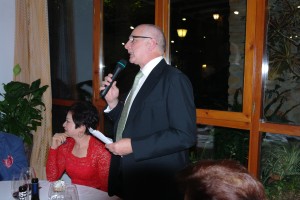
Phil Fraser proposing a vote of thanks
metres- cold winters, very hot summers and a big range of temperature from day to night. Good conditions for growing Tempranillo. Florentino achieved Vino de Pago status in 2009 based partly on the quality of their wine but also on their differences compared to nearby vineyards: they just produce one wine, it is not filtered or clarified in amy way and most neighbouring vineyards are in valley bottoms whereas Florentino sits on a south facing hillside – ideal in terms of maximising sunshine. They prune the vines so as to harvest just 2.5 kgs per plant, which compares to 10 or 15 kgs per plant harvested by neighbours. It is aged about 8 months in French & American oak with new barrels every year. The colour is a deep cherry red and on the nose there are intense aromas of sweet spices, toasted oak and roasted coffee. The wine is quite clean on the palate and has a long creamy after taste.
A vote of thanks was proposed for Cherry and Tony by Phil Fraser
Text edited by Gaby Ferenczy from Cherry and Tony’s tasting notes 18th March 2016
As Cherry made reference to the Brussels bureaucracy, the President thought you may like to see this short clip of many years ago from “Yes Minister”
https://dotsub.com/view/229ca3b5-e82f-4162-9e9d-1b6ad4af9cb2