
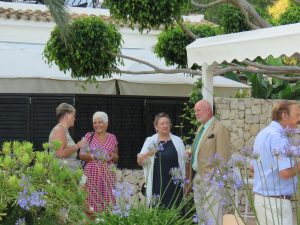

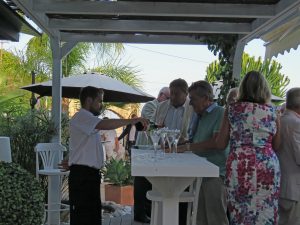
After a week of above-average temperatures members were evidently in thirsty mood as we gathered in the beautiful gardens of Puerto Blanco in Calpe, our traditional end of term venue. President John Sloggie welcomed members and a larger than usual number of guests, some 71 in total.
He went on to introduce the speaker for the evening, assuring us that despite his exotic name John Davis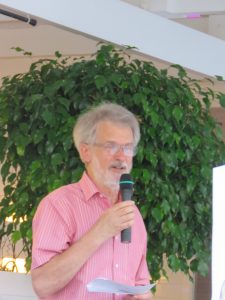 spoke perfect English.
And so it proved. John Davis started by congratulating the Society on its 25th anniversary, and told us that 2017 marked his 50th year in the wine trade. In his early days he saw many dubious practices, but the trade had to clean up its act after the UK adopted the European appellation rules in 1971. In the early 70s French grapes were planted all over Europe, and in particular in Italy, giving rise to what came to be known as the “Super Tuscans”. But more recently indigenous grapes have seen a resurgence, and his idea for the evening was to showcase Spanish single grape variety wines.
Five wines were presented, two white, two red and a cava. The cost of each wine and scores awarded by members can be found by clicking on “Wines tasted in 2017” . All wines are either in stock or available to order from Casa del Vino in Javea.
The first wine we tasted was an Albariño from Rias Baixas, a 2015 Bagoas Ledas from Bodegas Aquitania, which weighs in at 13.5%.
Albariño is one of the most distinctive white wine grapes in Spain. In the past, it was commonly mixed with other local grapes such as Loureiro, Godello, Caiño, Arinto or Treixadura to produce blended wines, but since the mid-1980s the grape’s full potential has been realised and appreciated for single varietal bottlings.
The vineyards are sited in the Salnés Valley on granitic soils, the bedrock often being close to the surface that facilitate drainage, vital in a Galicia where the annual rainfall average is high.
Pale yellow wine with green highlights; light release of natural carbon dioxide. Aromas hint richness and complexity, with a predominance of green fruit. On the palate there are touches of both sweetness and salinity, In John’s view it “knocks Sauvignon off its perch”.
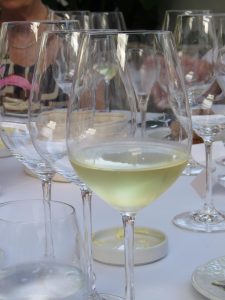 The second wine was a Merseguera from Tierra del Terrerazo, a 2013 Finca Calvestra from Bodegas Mustiguillo 13.5%.
Merseguera is a little-known white wine grape variety grown along the south-eastern coast of Spain. There are 31 synonyms for the name of the grape, which perhaps explains why it is little known. It was rarely used to make single-variety wines, as it lacked the varietal character so was best used in blends. However it is very tolerant of warm, dry climates.
The Calvestra Estate is located at an impressive 900 metres above the Mediterranean, one of the highest vineyards of the region. Finca Calvestra is a selection of the best grapes from sloped vines. The soils are made up of limestone, with sand and pebbles on the surface.
If you think of a Chardonnay, Roussanne and Viognier blend, you will not be far away. A year’s ageing in Burgundian barrels adds mealy honeyed notes to a citric core, with gentle hints of cinnamon and clove on the back palate.
The third wine and first red was a Bobal from Utiel-Requena, a 2013 “La Malkerida” from Bruno Murciano, 12.5%
Bobal is a dark-skinned wine grape variety native to Utiel-Requena. Despite its relative obscurity it is one of Spain’s most planted grape varieties behind Tempranillo and Airen. Bobal grapes have long been used as a minor blending partner to the region’s more glamorous grape varieties. Now, more producers are turning toward varietal Bobal wines.
The vines for this wine are 80-year-old bushvines at up to 950 m altitude in Utiel-Requena.. They decided to call the wine La Malkerida, which means ‘the unloved woman’, because they feel that Bobal has been unfairly unloved. Smoky aromas give way to a luxuriant and smooth palate with a hint of game yet it’s really delicate.
As it says on the bottle:
“At the state of being completely forgotten, for the shadows that you did not lead and the same ones that you ever received. Your anonymity is our inspiration, your history character and personality our better flag”
Me neither.
The fourth wine was a Prieto Picudo from Castilla y Leon, a 2014 Tridente, Crianza from Bodegas Triton, which comes in at a hefty 15%.
Prieto Picudo is a rare, dark-skinned variety grown predominantly in and around its homeland of Leon, northern Spain. It grows best in difficult terrains, hot and dry being its preference as it has a high degree of drought resistance.
The facilities of Bodegas Tridente are located in Villanueva de Campean, in the heart of Tierra del Vino. The micro-cellar is designed to make small elaborations of red grapes native to the area such as Prieto Picudo. The fermentation took place in small stainless steel tanks then remained for 15 months in French oak barrels.
Intense in terms of both colour and flavour, showing redcurrant, blackberry and liquorice flavours. This wine has mineral notes with vanilla and toast from the oak.
Our fifth and final wine was a cava: Xarel-Lo from Penedes, an Els Capricis from Vilarnau “Castanyer”.
Rarely seen in the UK as a varietal wine, Xarel-Lo is more commonly found as a constituent of cava and other Catalan blends. It is one of the region’s most widely planted varieties, valued by winemakers for the acid structure it brings to wines, and stands out as one of Spain’s finest white-wine varieties.
Members of Spainish nobility, the Vilarnau family settled in Penedés during the 12th century. The soil here is alluvial in origin, formed from layers of lime and clay, and specialise in small-scale, artisan production of exclusive, high quality cavas. This Xarel-Lo’s unique feature lies in the fact that it has been 100% fermented and 25% matured in chestnut barrels for six months.
Intense golden yellow. The nose is complex, combining tropical fruits with ripe apple, subtle balsamic nuances, vanilla and an intriguing nuttiness – this undoubtedly from the use of chestnut casks. Smooth, fresh and lingering on the finish.
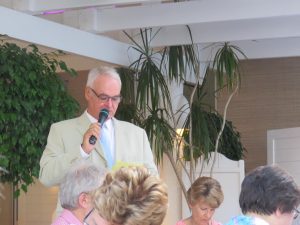 John Sloggie thanked John Davis for his talk and choice of wines, which was met with applause. John explained that he wanted to thank the speaker himself because he wanted also to take the opportunity to pay tribute to the hard work of his committee and asked them to stand in order to be recognised, to their evident embarrassment. He also thanked Thamar of Casa del Vino in Javea for the efforts she had made to source the wines for the evening. He noted the sad death of Fausto Vicente. Finally John wished all present a good summer.
Text by Mike Granville Photos by Helen Granville June 2017