
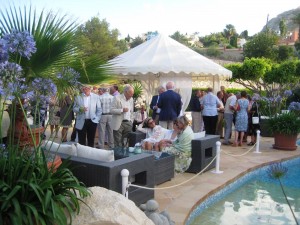
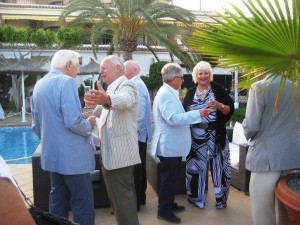
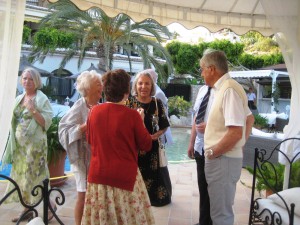
Members enjoying pre dinner drinks in the gardens
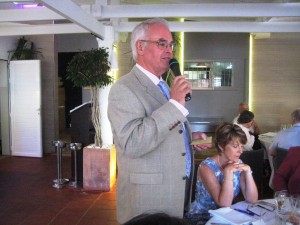
John Sloggie welcoming diners
Puerto Blanco is our well established venue for the June tasting and a very popular venue it always proves to be. This year proved to be no exception as in addition to our members it attracted 19 guests. Two of our members, Kathy and Andrew Johnson were presenting both a horizontal and a vertical tasting.
Andrew kicked off the proceedings by explaining the difference between these two forms of tasting.
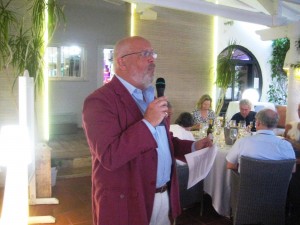
Andrew Johnson
A horizontal tasting compares wines from the same year but from different producers and highlights the difference between wine-making styles. A vertical tasting involves wine from the same producer but from multiple years and illustrates the difference between vintages. In order to provide some continuity, Kathy and Andrew chose all the wines from the same region; Somontano, which is a Denominación de Origen (DO) created in 1984, and located in the county of the same name, in the province of Huesca, in Aragon. The cost of each wine and where it can be purchased (if applicable) and average score given by members is shown in the list of wines tasted in 2016, which can be found by clicking on “Wines tasted in 2016”.
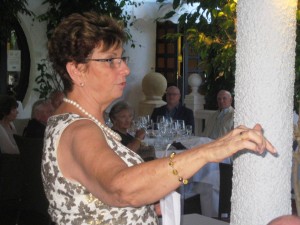
Kathy Johnson
The first wine in the horizontal tasting, which was covered by Kathy, was a Viñas del Vero Chardonnay Colección, 2015. Viñas del Vero is the leading producer in the area, and a part of the Gonzalez Byass family of wine. It is now the leading winery of the Somontano region in terms of the volume and quality of its output. The wine is prepared by cold maceration of the freshly harvested grapes which helps to protect the typical characteristics of the grape. The colour is straw yellow with a bright clean appearance. On the nose it has floral, citrus tropical fruit and herbal notes, while in the mouth it is fruity, fat and thick with citrus notes and a long persistent aftertaste. It has an Alcohol by Volume (ABV) of 13.5%, is currently unscored, but previous vintages have scored between 89 and 91 points in the Guía Peñín.
The second wine was Enate Chardonnay – 234 another young wine from 2015. This is one of three white wines from this Somontano winery. It is a very bright wine, pale yellow in colour, it begins with a lightly aromatic nose that intensifies with a bit of aeration, and exudes an array of pure varietal aromas: apple, peach, fennel and exotic fruits on a discrete mineral background. Full-bodied, buttery, clean and fresh on the palate, it has a syrupy touch to the aftertaste. This wine has won pretty much every award going, including the Brussels Concourse Gold award. The ABV is 14.5% and the Guía Peñín awards it 91 Points.
We then moved on to three reds Enate Reserva Selección, but this time in a vertical tasting, which was dealt with by Andrew. These excellent barrel aged tinto reservas were from the vintages, in order of tasting, of 2009, 2008 and 2007. In these ENATE have produced three wines of clearly the same pattern, but with a character that is different for each vintage. In all cases the strategy is based on the grapes. After stemming and crushing, they are fermented separately at 260 C in stainless steel tanks. After malolactic fermentation, the wine is aged in 225 litre oak barrels for 18 months. The challenge is to create a positive balance between fruitiness and spicy oak nuances. The Cabernet Sauvignon is aged in French oak barrels, which, as we know, are richer in tannins and roasted aromas, while for the Tempranillo they opt for American oak, with its lighter and richer tannic compounds reminiscent of coconut and vanilla. These wines are all 14.5% ABV. Over the years, this wine has been awarded Peñín’s “Podium” position, with exceptional scores in the range of 91 to 94 points.
2009 – The start of the 2009 vintage came in a rush in mid-August, because a heat wave ripened the grapes earlier than expected. The summer was very dry and the rains did not arrive until the end of September, and even then there had been barely 30 days of rain in the year. Of these three the 2009 is the wine with the most potential for bottle aging. It has more life ahead thanks to more lively tannins, a stronger palate and a fruity nose (blackberries, blueberries), along with spicy hints of pepper and vanilla.
2008 – By contrast the months of April and May for this year were quite rainy, with a lower than usual temperatures and June arrived with storms and strong winds. This caused a significant delay in the start of the harvest, which began on August 27 and a significant decrease in grape production.

Mike Granville proposing the vote of thanks
Because of the weather, in this vintage, the 2008 is where the most serious and Atlantic tone Cabernet Sauvignon combines perfectly with the Mediterranean sweet tooth, and flattery of Tempranillo, giving a wine with a very appealing nose, with notes of mature fruit and hints of roasted coffee. The palate is friendly, and pleasantly long.
2007 – After a rainy spring, which was colder than usual, a very dry July, with only moderate temperatures, the harvest started on August 20. The mild summer temperatures allowed the grapes to reach maturity slowly and gradually giving rounded wines without vegetal notes that can hinder Tempranillos. This 2007 has a complex nose with hints of leather, smoke and balsamic. its dense and meaty palate makes it the most flattering wine in this series, full of nuances, able to combine skilfully with delicacy and power undoubtedly is the one most mature of the three. Gordon Sellars, one of our members researching this wine on line after the tasting and found some at 70€ a bottle!
A vote of thanks to Kathy and Andrew was proposed by Mike Granville.
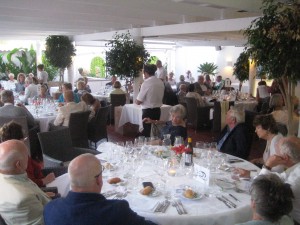
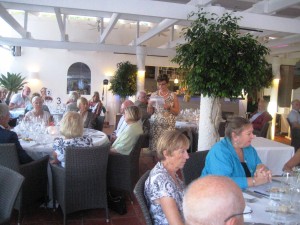
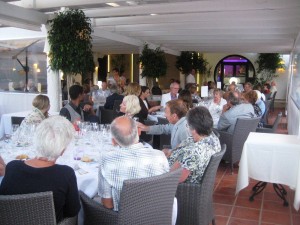
Diners enjoying the meal and tasting
Text from Kathy and Andrew’s notes, by Gaby Ferenczy, photos by Gaby Ferenczy 17th June 2016